
When you hear “CBCT scans” or “3D printing,” you might picture something from a science fiction movie. It sounds complicated. It sounds expensive. And you might wonder, “Do I really need all that?”
But these tools aren’t just fancy gadgets. They make your dental care safer, more precise, and often more comfortable. Here’s how.
CBCT Scans: Seeing What X-Rays Can’t
You’re probably familiar with traditional dental X-rays. They’re great for spotting cavities and checking basic bone levels. But they give you a flat, two-dimensional picture.
A CBCT scan, that stands for Cone Beam Computed Tomography, is completely different. It creates a 3D image of your teeth, jaws, nerves, and sinuses. Think of it like a Google Earth view of your mouth. Your periodontist can rotate the image, zoom in, and see exactly what’s going on from any angle.
Why does that matter for you?
- Precision: When we’re placing a dental implant, we need to know exactly where the bone is thickest and where nerves and sinuses sit. With a CBCT scan, we can plan the implant placement down to the millimeter before we even start.
- Fewer surprises: No more guessing. We know what we’re working with before we make the first incision. That means fewer complications and a smoother procedure.
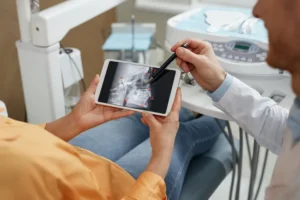
- Better communication: We can show you the 3D image on a screen and point to exactly what we’re talking about. You don’t have to take our word for it. You can see it yourself.
The scan itself takes about 30 seconds. You just sit still while the machine rotates around your head. It’s completely painless.
3D Printing: From Digital Plan to Physical Guide
Here’s where things get really interesting. Once we have that 3D image from the CBCT scan, we can use it to design your treatment digitally. Then we print a physical surgical guide using our in-office 3D printer.
Think of a surgical guide like a custom-made template. It fits over your teeth and gums and has tiny holes that show us exactly where to place the implant. There’s no guesswork. No “eyeballing it.” Just precision.
What that means for you:
- Shorter procedures: Because we’ve already planned everything in advance, the actual surgery takes less time. You spend less time in the chair.
- Less discomfort: With a surgical guide, we make smaller incisions and disturb less tissue. That usually means less swelling and a faster recovery.
- Better results: The implant goes exactly where it should, at the right angle and depth. That means it’s more likely to last for decades.
- Same-day convenience: Sometimes, we can do the planning and printing right here in the office. For some patients, that means fewer appointments and less waiting.
A Real Difference
Let’s say you’re getting a single dental implant. Without CBCT and 3D printing, your periodontist would rely on X-rays and experience to guess the best placement. It usually works. But there’s always some uncertainty.
With CBCT and 3D printing, we take a 3D image, design the perfect implant position on a computer, and print a guide that fits your mouth. When you come in for surgery, everything is mapped out. The implant goes in with pinpoint accuracy. You heal faster. And you walk out with a smile you can trust.
Technology with a Human Touch
Technology is only as good as the people using it. At North Shore Perio & Implantology, our team has years of experience using CBCT and 3D printing to help patients just like you. We don’t use tech for tech’s sake. We use it because it gives you better care.
Curious about how these tools could help you? Call us at 708-834-7080 or schedule a consultation online. We’re right here in Skokie, and we’re happy to show you around.